Showing posts with label cycle houses. Show all posts

Monday, 12 January 2009

Not green: grey

First published on Green Bristol Blog Tuesday, 11 November 2008

Back in March thousands of Bristolians were out making a public show of how much they loved the Bristol & Bath Railway Path. The most popular railway-to-path conversion in Britain, this path is said to attract 2.4 million trips a year on foot and on bike; walking to school, cycling to work, running for fitness, walking the dog, enjoying the greenery. The proposals to run Bus Rapid Transit down the path shocked everyone who used the path, who couldn't believe that their path, their park, was going to be taken away. Yes, a cycle lane would remain down the side of the path, but there would be little greenery, just concrete and buses.


We stopped it. Together, those thousands of people created the single largest on-line petition in Bristol's history, while the walk down the Path and College Green rally was one of the largest demonstrations the city has seen in the past decade -a friendly and peaceful day out for everyone involved. When the council leaders announced their change of heart, we all breathed a sigh of relief.

We breathed too soon. Because while the councillors were agreeing with us -the Railway Path is a special part of East Bristol- the council officers were talking to George Ferguson's architects and developer Squarepeg about building houses on the green margins of the Path up at the old Chocolate Factory site in Easton. This is a development where the community successfully prevented the previous developers from creating a featureless cul-de-sac of suburban houses, and we were all looking forward to the development. Imagine then, our surprise and disappointment when the proposal included building on the green margins of the path, with stairs to provide "bicycle access" to the path. Because as everyone knows: bikes and stairs are such a perfect combination.


Imagine our even greater surprise when the freedom of information requests gave us the email discussions going on behind the scenes, where we discovered that:
  1. Negotiations over use of the park land has been ongoing since March.
  2. Both the BRT planners and the Parks department said they needed the land
  3. One council officer, David Bishop, managed to fix things by overriding the other officers and the local Green Space strategy
Given that most of these 'cycle houses' will have steps to the path, they are more accessible by bicycle from the other side, from their garages. Why then has George Ferguson's team chosen to push anti-cycling houses onto the Bristol-Bath path? One email shows the reason: to add 25 more parking spaces.

For more information see:
Stop press....1.30 pm


Seeing red. George arriving late at the Watershed this morning for the 'this green and pleasant land' conference, only to be confronted by our leafletteer, publicising the Chocolate Factory controversy. His comment? "Go do something useful".

Egregious Greenwash

First published on Green Bristol Blog Thursday, 18 September 2008

It can be a solitary business being a blogger. You dig here and there on the internet, extracting little nuggets of information to bolster your cynical observations on the ways of the world, but you rarely talk things through with real people. So when you finally click on the publish post tab extreme emotions are experienced for a few seconds. Are you making a valued contribution to human understanding - or a complete arse of yourself?


So it's very gratifying to get some positive feedback from time to time (hint), especially from such a respected source as Venue's Severn Bore column (well I'm a fan anyway). For those of you who have already read it and who have arrived here to find out more, I suggest you follow this link to run through the emerging story of "cycle" houses, clandestine land sales, deception and greenwash surrounding the proposed redevelopment of the Chocolate Factory site in Greenbank.


For the benefit of those who have not yet read the Venue piece, here it is -

If you're one of the 20 or so Bristolians who lurks in the local ishoos blogosphere, occasionally breaking cover to post comments ("Too right, m8, them counsellers are takin the piss"), you'll know that we've been pretty taken with an egregious bit of greenwash lately.

Briefly, Bristol (a Cycling City, don'tcha know) hopes to sell off penny packets of landholdings here and there to make ends meet. Meanwhile, a property development firm called Squarepeg, which proposes turning the former Greenbank chocs factory into flats, also unveiled plans for 'cycle houses' next to our famous and much-loved Railway Path. These would be on a thin strip of council-owned land between the chocolate factory and the path.

All this was uncovered by Chris Hutt in his Green Bristol Blog (greenbristolblog.blogspot.com). Not just the potential intrusion on to the path and the attendant grubbing up of a hedgerow, but he also took a close look at the designs of these trendy cycle houses put forward by Acanthus Ferguson Mann, whose ranks include the famously red-trousered George Ferguson, Bristol's patron saint of sustainable urban design.

Seems each cycle house would access the railway path via a set of steps - very handy if you've gotten home with a load of shopping. Not only that, but on the other side, they have garages as well. For cars!

As we go to press, nothing has yet had planning permission, a petition's been gotten up opposing the sale of the land by the path to developers, and there are now sketches of the proposed cycle houses, this time with ramps. Score one to some careful digging by an amateur, score no to greenwash.

Second bite of the Cherry Trees

First published on Green Bristol Blog Saturday, 13 September 2008

Poking into the background of Squarepeg's plans for the Chocolate Factory at Greenbank keeps throwing up new discoveries. Having highlighted the clandestine sale of part of the Railway Path land on the part of the Council, Squarepeg's dishonesty in declaring the status of the land purchase in their newsletter and the vacuity of George Ferguson's claims for his cycle houses, I now have more to reveal.

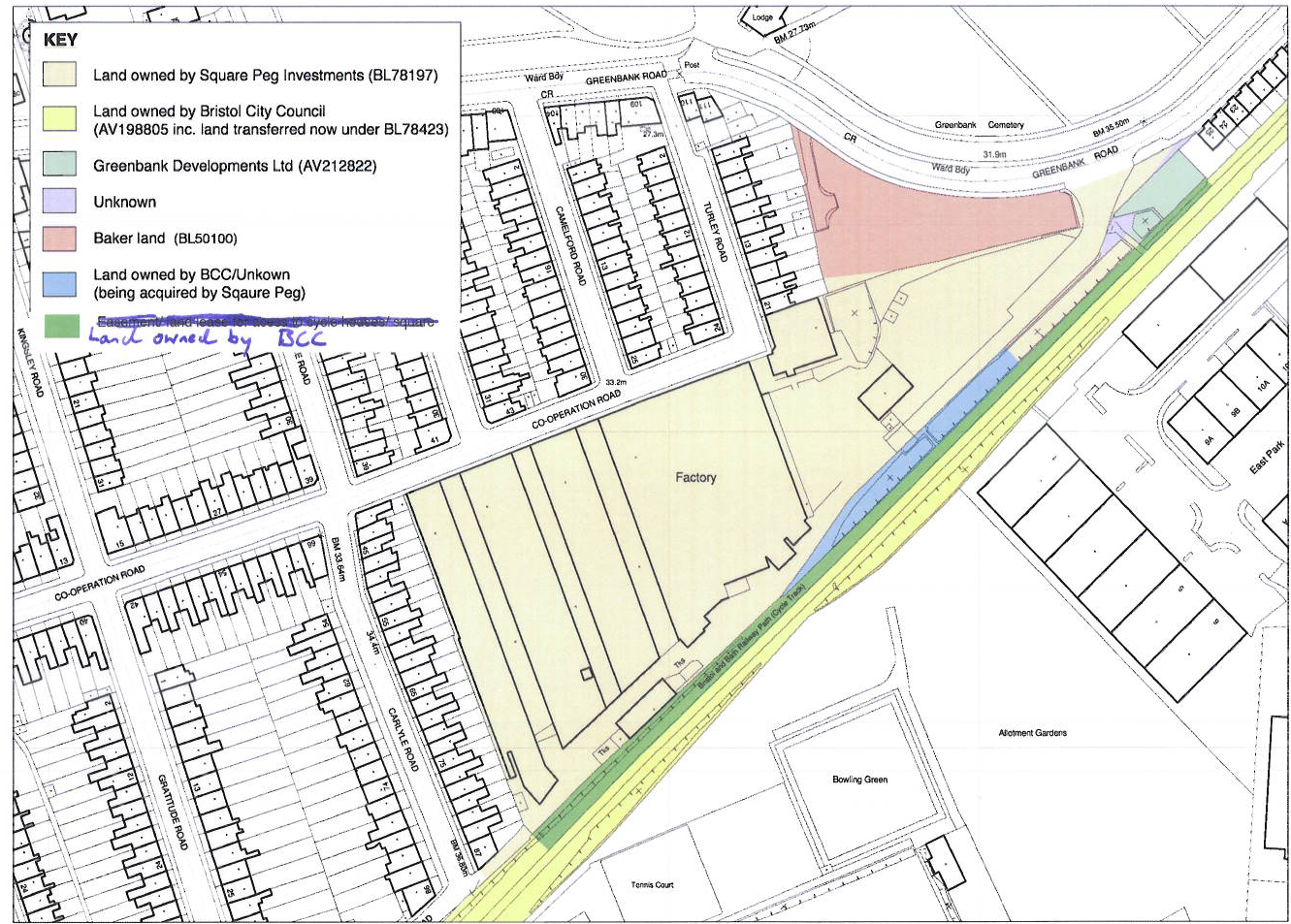
Back around the year 2000 there was a planning application for the construction of a row of what George Ferguson would have us call cycle houses, namely bog standard rabbit hutches, along the embankment slope of the Railway Path just to the east of the Chocolate Factory site facing onto Greenbank Road. The application was made on behalf of Greenbank Developments who had bought the land from British Rail Property Board (the City Council having declined to purchase the former railway land when it was originally offered to them for a peppercorn).


The land (the pale green and pale yellow sections of the embankment on the map above - click to expand) owned by Greenbank Developments included the Railway Path embankment slope as far southwest as the land now being sold by the Council to Squarepeg. The land included a mature hedgerow (an extension of the very same hedgerow now threatened by Squarepeg) which the Council's Nature Conservation and Landscape Officers were anxious to preserve. Concerns were also registered over the impact on slow worms and badgers, both protected species, which were both known to be present on the land.

In the event Greenbank Developments were only permitted to construct on the section of the embankment slope which ran directly alongside Greenbank Road, on condition that the hedgerow was preserved, and the remaining embankment slope land that continued alongside the Chocolate Factory car park was left undeveloped. This residual land included an area near the car park entrance which was specifically identified in the Planning Permission as to be preserved as a wildlife area (below) on account of its collection of mature trees.


All the residual land, including the designated wildlife reserve, has recently been purchased from Greenbank Developments by Squarepeg and now forms part of their development proposals. As with the land being sold to Squarepeg by the Council, the intensive development proposed will totally destroy the hedgerow and the designated wildlife area will be largely obliterated and replaced by two 4 storey blocks of flats!

Now it is inconceivable that Squarepeg did not already know about the planning history affecting their proposals. They will have had preliminary discussions with a variety of Council Officers, some of whom must have been aware of such recent planning decisions. Besides which the documents recording the planning decisions are easily found on the web (so much for my investigative prowess). Yet I can find nothing referring to this issue on the Chocolate Factory web site.


Perhaps Squarepeg thought the destruction of over 150 metres of mature hedgerow (above) and a designated wildlife site were obscure details that would not interest local residents. Or perhaps they deliberately kept quiet about this, as they have about the details of land purchases, in the now forlorn hope that nobody would notice until it was too late.

Step forward the Cycle Houses

First published on Green Bristol Blog Saturday, 6 September 2008

All this Chocolate Factory fracas with George Ferguson started back in May when I dared to question his pet project by asking "what are cycle houses?". Well, it seems that at last we have an answer.

The developer, Squarepeg, have suddenly realised that some naive souls might have taken the previously published sketches (e.g. below) as indicative of the design of the cycle houses. Oh dear, how simple minded the common people are.


So "to put the record straight" they have produced some new sketches, with a lot more green on them. Now, don't be foolish and think these are "definitive designs" or anything like that, will you. They are just to "illustrate the idea" of the cycle houses, and can be changed willy-nilly any time Squarepeg feel like it. That's how public consultation works these days, apparently.


The first of the new sketches (above) shows a section through the 4 storey cycle house showing the ground floor garage (although they have somehow neglected to name this) and access from the 2nd floor cycle store to the Path, based on the 4 metres of clearance that will exist between the majority of the houses and tarmac path edge. One can see that the 2nd storey floor is about 2 metres above the Path level, so a "bridge" linking the two would have a slope of at least 1 in 2, or 50%.

Now a 50% slope is way too steep for a ramp (as shown in all their previous sketches and as described in their publicity as "a seam-free sloping pathway" ), so they've had to settle for steps, about 10 of them to conform to the building regulations. So our intrepid cyclist, returning from the supermarket with panniers (or even a trailer) filled with groceries, is expected to manoeuvre her heavily laden bicycle up a flight of 10 steps to reach the bicycle store.

Or she might just nip round via the parallel street to the other side of the house and have a level access into the integral garage.

So there we have it, a cycle house is a standard 3 bed family house with vehicular and bicycle access from the street where the generously proportioned garage will provide ample car and cycle storage, but with the option of nipping out the back door directly to the local path if you're walking somewhere. Undoubtedly a "groundbreaking" concept and "a world first" as George Ferguson so modestly proclaimed back in May.

Square Pegs and Round Holes

First published on Green Bristol Blog Wednesday 3 September 2008

Since my previous post more details have emerged about the clandestine deal whereby one of the embankment slopes (pictured below) of the Railway Path is being sold off by Bristol City Council to a property developer, Squarepeg, to allow the construction of housing including a twin tower block which will loom over this section of the Path.


Contrary to the claim made by Squarepeg in their newsletter dated 1st July, the sale has not yet been completed (although now at an advanced stage), even two months later. So anyone concerned about the loss of parts of the Railway Path green corridor would have been under the impression that the sale was a done deal, a fait accompli, and would have concluded that it was too late to make objections to the sale.

And people are concerned. The land in question is an integral part of the former railway land and supports mature vegetation and bushes rising to at least 5 metres above Path, so providing a green wall (screening off the derelict car park beyond) and of course a valuable wildlife corridor. Despite the sale appearing to have gone through concerns are being expressed by those anxious to preserve the rural ambiance of the Path (running along the left edge of the sketch below).


The Squarepeg newsletter states "... the development area could be significantly improved with the inclusion of two small pockets of undeveloped land immediately adjacent to the site. .... negotiations to purchase both plots of land have been successful and the application now includes ... a strip of land that runs along the cycle path."

Now anyone reading "negotiations to purchase....have been successful" can only conclude that the deal has been done, yet we now know at that stage negotiations were far from complete. To compound this, er, economy with the actuality on the part of Squarepeg the other party to the deal, Bristol City Council, took the view that they had no obligation to consult with anyone whatsoever. That may conceivably be correct on a technicality, but, as noted elsewhere, it hardly sits well with the spirit of their policies relating to the sell-off of our parks and green spaces.

But returning to Squarepeg, they have made much of their willingness to consult in depth with local people and appear to have gone to some trouble to do so. No doubt the Planning Application due to be submitted any day now will make much of these consultations and the extent to which their proposals enjoy local support.

But in view of what appears to be a significant misrepresentation we must now look again at the legitimacy of those consultations and in the meantime the sale of the embankment slope should be put on hold until proper consultation has been carried out.

Cycling City Secret Sell-Off?

First published on Green Bristol Blog Friday, 29 August 2008

It seems that Bristol City Council have let the excitement of being declared the UK's first Cycling City rather go to their heads. Barely months after massive public opposition forced them to backtrack on plans to convert the Bristol & Bath Railway Path to a high speed bus route, they now appear to be selling off strips of that same precious green corridor to property developers for speculative housing developments.


The case that has emerged concerns the Chocolate Factory development at Greenbank. As reported here way back in May a property developer, Squarepeg, plan to build terraced housing along what we first assumed to be the boundary of the Railway Path, but closer inspection of the plans suggested that the planned housing might intrude onto the Railway Path land. We now discover that the City Council are going ahead with the sale of a substantial strip of the former railway land to Squarepeg to accommodate this housing.

Such hubris on the part of the City Council is not so surprising. If the reward for planning to virtually destroy the nation's preeminent cycle path was to be awarded over £11 million of Cycling City funding, what should they fear from a clandestine sell-off of the green margins? Of course the usual suspects are in on the deal - Bradshaw*, Sustrans, George Ferguson and other latterday luminaries who now promote themselves as patrons of green transport.


But what of the thousands of ordinary Path users who campaigned so heroically to save the Path from the Council's misguided transport plans this spring? Have they been consulted? Did they even know anything of the planned sell-off? It seems not, at least not until after the event, when a small print announcement appeared in Squarepeg's newsletter tucked away under the attention grabbing heading "coherent approach creates combined application" (zzzzz) reporting that "negotiations to purchase ... have been successful and the application now includes.....a strip of land that runs along the cycle path".

There are mixed views on this high profile development, as might be expected, and many people are expressing concern at the loss of the green corridor which is as vital a component of the Railway Path as the tarmac path. For all we know, it may even be that the tarmac path itself may be moved over from its existing alignment to maximise the land available for the housing, so the green margins may be degraded on both sides.


There are also concerns about conflict between Path users and residents of the houses, particularly small children and pets, who might emerge suddenly from the concealment of the access ramps into the path of a cyclist. The last thing Path users want is to be put into a position where they are endangering others, especially children. Yet it's clear enough (except apparently to Sustrans) from the sketches supplied that that is exactly what will happen.

But fear not, the City Council always know best and will in due course give their approval to the Planning Application, expected to be submitted next week. They have, according to Squarepeg, already preempted the decision by selling off the land.

What are Cycle Houses?

First published on Green Bristol Blog Sunday, 25 May 2008

Bristol based architect George Ferguson has proposed the construction of a number of "cycle houses" alongside the Bristol & Bath Railway Path in Easton as part of the redevelopment of the Chocolate Factory. George, never one to understate things, describes this as a "world first" and a "groundbreaking proposal". So what exactly are "cycle houses" and what makes them so different to common or garden houses?

Looking at the plans, we see that these are basically 3 bedroom houses with ground level car parking, but with a bicycle store at 1st floor level, which in turn is linked directly to the Railway Path by a small bridge. Planting will create a green screen between the houses and the Path for privacy, but at the third floor level the living room and sun terrace will overlook the Path. Previous housing developments along the Path (e.g.
Clay Bottom, Brixton Road) have tended to turn their backs on the Path so this more Path oriented aspect is welcome.


But is this sufficient to justify calling these "cycle houses", let alone "groundbreaking" or "a world first"? It's not as if these houses forgo having their integral car parking spaces, nor is the development as a whole anything other than car oriented. And this at a time when the option of genuinely car-free housing is at last being discussed. What better location for car-free housing, alongside what is probably the best example of a high quality urban cycle/walkway in the country, giving easy, rapid access to the city centre and both local and main railway stations?

There is another reason for concern about this proposal. It appears from the plans that the cycle houses will encroach onto the Railway Path land, cutting into the lower section of the embankment. Could it be that the hype around these "cycle" houses is designed to persuade the public to accept this publicly owned land being taken for private development? Were the houses presented as nothing more than 3 bed houses with integral car parking (which is what they appear to be) public reaction to encroachment onto the Railway Path might be rather different.